

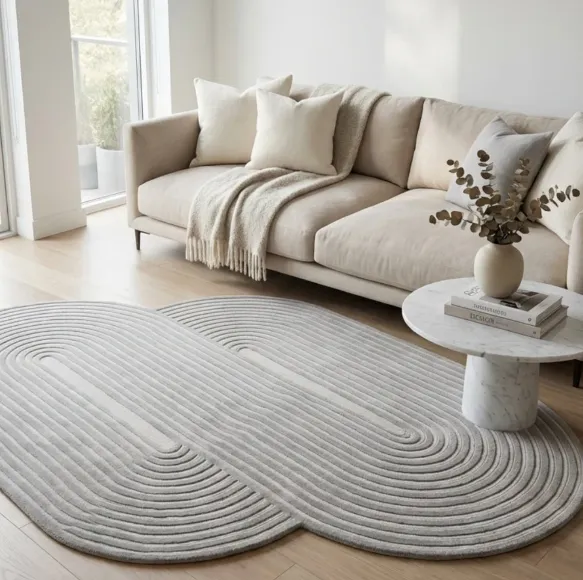
The biggest mistake Indians make while buying carpets is treating them like a floor accessory. They are not.
An authentic handmade carpet can decide whether your living room looks properly put together or like the furniture was placed randomly during a house-shifting day. Yet most people still buy carpets using the most dangerous criteria possible: “This colour looks nice” or “This offer looks too good”
That is how you end up with a tiny area rug floating in the middle of a large room, a fluffy hand knotted carpet that becomes impossible to maintain, or a bold design that looked exciting online and unbearable after two weeks.
The current shift in Indian interiors is moving away from treating area rugs as an afterthought. Larger floor pieces, warmer tones, visible texture and more character-led interiors are increasingly being discussed as stronger choices than the old grey-and-white, ultra-minimal formula. Do not buy carpets to fill empty floor space. Buy them to solve what the room is missing.
And if you want a safe starting point, cream carpets are not boring. Badly chosen cream carpets are.
A Carpet Should Fix the Room Before It Decorates the Room
The best carpet is the one that makes the entire room look more intentional, even before you notice its design. This is the first thing Indian buyers need to understand: a designer carpet is not an isolated product. Its real job is to connect furniture, colour, texture and space.
What a good carpet should actually do
- Anchor the furniture: The sofa, chairs and centre table should feel visually connected.
- Control visual emptiness: Large rooms often feel unfinished because the floor has no defined zone.
- Add warmth: Especially useful in homes dominated by marble, vitrified tiles, glass and plain walls.
- Introduce texture: A textured carpet can make a neutral room feel richer without adding more clutter.
- Create proportion: The right size can make a room feel balanced. The wrong size can do the exact opposite.
The oversized rug approach is particularly relevant to Indian living rooms. A carpet should generally relate to the seating arrangement rather than sit like a small decorative island in the centre of the floor. If your carpet does not visually connect the furniture, it is probably too small for the room. That one rule can save you from a surprising number of bad purchases.
Cream Carpets Are Not “Safe”. They Are a Serious Design Decision.
Cream wool carpets work because they can carry the room without fighting for attention. But cream is not one colour, and that is where most buyers get it wrong.
People often hear “cream” and imagine one generic pale shade. In reality, the difference between ivory, warm cream, oatmeal, beige and yellowish cream can completely change how a carpet behaves in a room.
The right cream carpet depends on your room
- Warm cream: Works well with wooden furniture, brass, terracotta and warmer Indian interiors.
- Ivory: Brighter and more formal, but less forgiving in high-traffic spaces.
- Oatmeal or natural cream: Excellent for textured, relaxed and contemporary homes.
- Beige-cream: More practical where dust and daily foot traffic are concerned.
- Tonal cream patterns: Better than plain solid surfaces if you want subtle depth without visual noise.
Cream and other warm neutrals are currently being used more through texture and tonal variation rather than as completely flat, lifeless surfaces. A cream carpet should add depth to a room, not disappear into it.
This is why texture matters. A cream carpet with raised patterns, different pile heights or subtle weaving variation can feel far more interesting than a completely plain white surface.
Stop Buying a Carpet Based on Looks Alone. Indian Homes Have Different Problems.
A carpet that looks beautiful in a product photograph may be completely wrong for your actual lifestyle. This is where generic decor advice usually becomes useless.
Indian homes deal with dust, frequent visitors, festivals, children, food spills, shoes, domestic help, pets and different weather conditions. The practical question is not simply, “Does this carpet look premium?”
Ask instead: “Can I actually live with this?”
Before buying carpets, check these five things
1. Foot traffic
Living rooms and busy areas need practical constructions. High-maintenance options should be chosen with your lifestyle in mind.
2. Material
Wool, cotton, jute, synthetics and blends all behave differently. There is no universal “best” material.
3. Pile height
A soft, high-pile carpet may suit a bedroom but can be less practical in a heavily used area.
4. Colour tolerance
Very pale carpets can look beautiful, but a warm or patterned cream may handle everyday visual dust better than bright white.
5. Size before style
A beautiful carpet in the wrong size is still the wrong carpet.
Current buying guidance increasingly emphasises matching pile, material and maintenance requirements with the room’s actual function rather than choosing only by appearance. Buy for the life you live, not the house you saw in a Pinterest screenshot.
The Real Problem With Most Carpet Shopping Is That We Start With the Design
You should choose carpets in the reverse order: space first, size second, lifestyle third, design last. Most people do the opposite. They fall in love with a design, force it into the room and then wonder why everything looks slightly off.
A better buying order looks like this
- Step 1: Measure the room and seating area.
- Step 2: Decide how the carpet will sit under the furniture.
- Step 3: Identify the level of daily traffic.
- Step 4: Choose the material and construction accordingly.
- Step 5: Select the colour family.
- Step 6: Finally choose the design.
This approach matters even more when buying online. You are not just selecting a picture. You are selecting a large visual surface that will occupy a major part of the room.
That is why browsing a wide range of sizes, textures and styles matters. For people comparing different options, Kesari Home offers carpets across varied designs and colour families, including cream-toned pieces that can work as a versatile foundation rather than a decorative afterthought.